
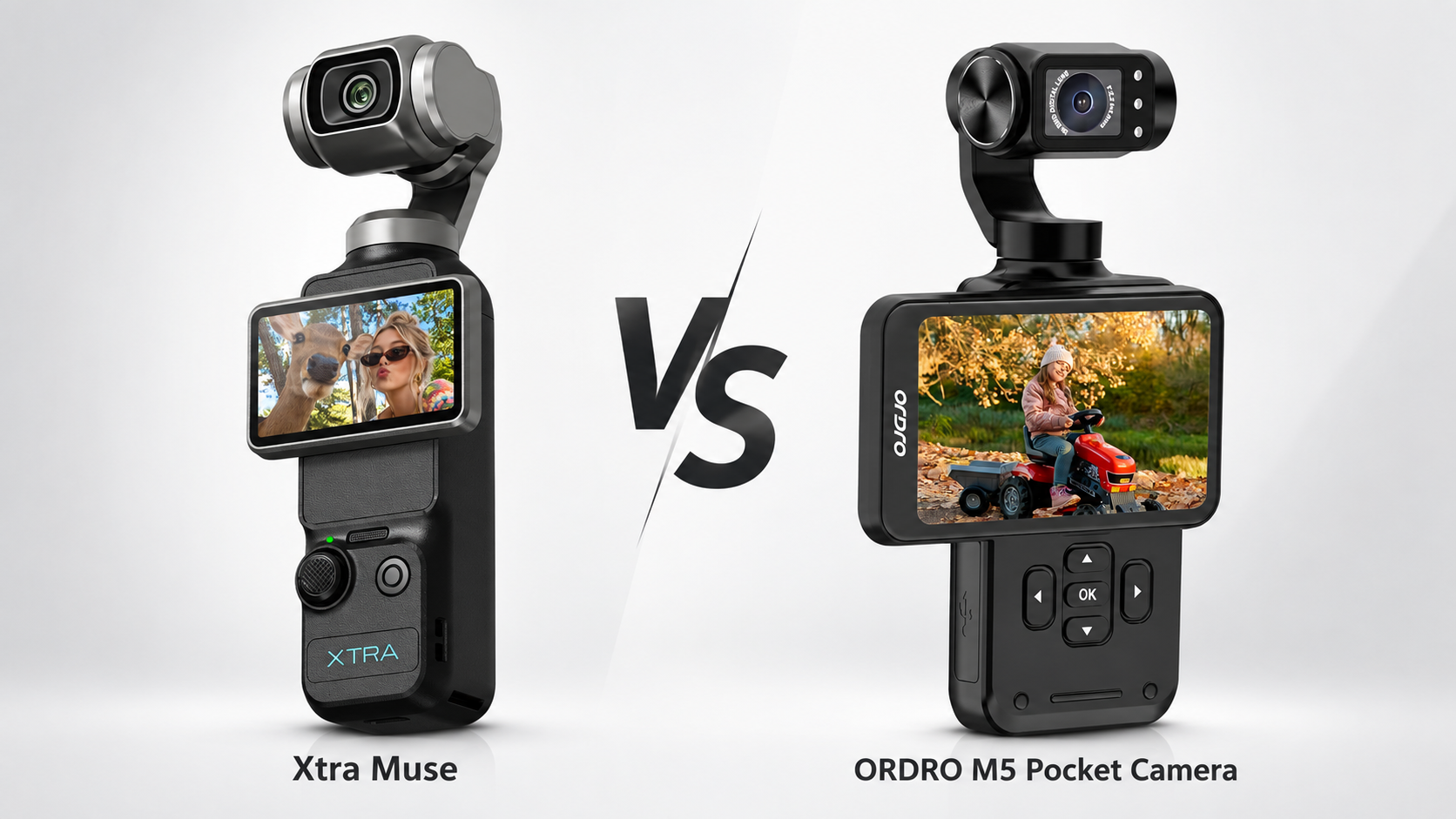
Xtra Muse vs. ORDRO M5 Pocket Camera: Which Vlogging Camera Is Better?
Looking for a compact camera that can record stabilized videos without requiring a separate gimbal?
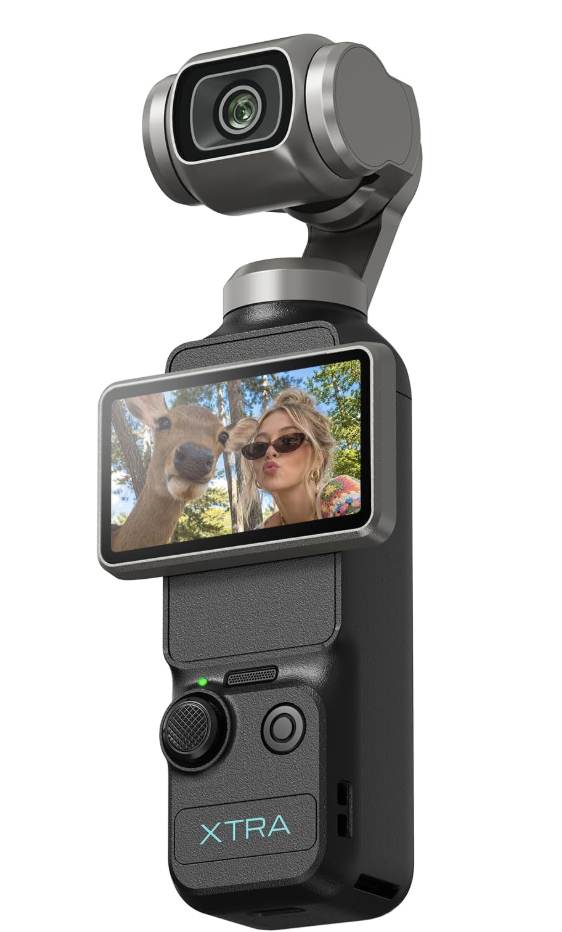
The Xtra Muse and ORDRO M5 are both designed for travel, vlogging, social media and everyday content creation, but they target very different buyers.The Xtra Muse focuses on image quality and creative control. It combines a large 1-inch sensor with 4K recording at up to 120 frames per second, 10-bit X-Log color, fast subject tracking and a compact rotating display.
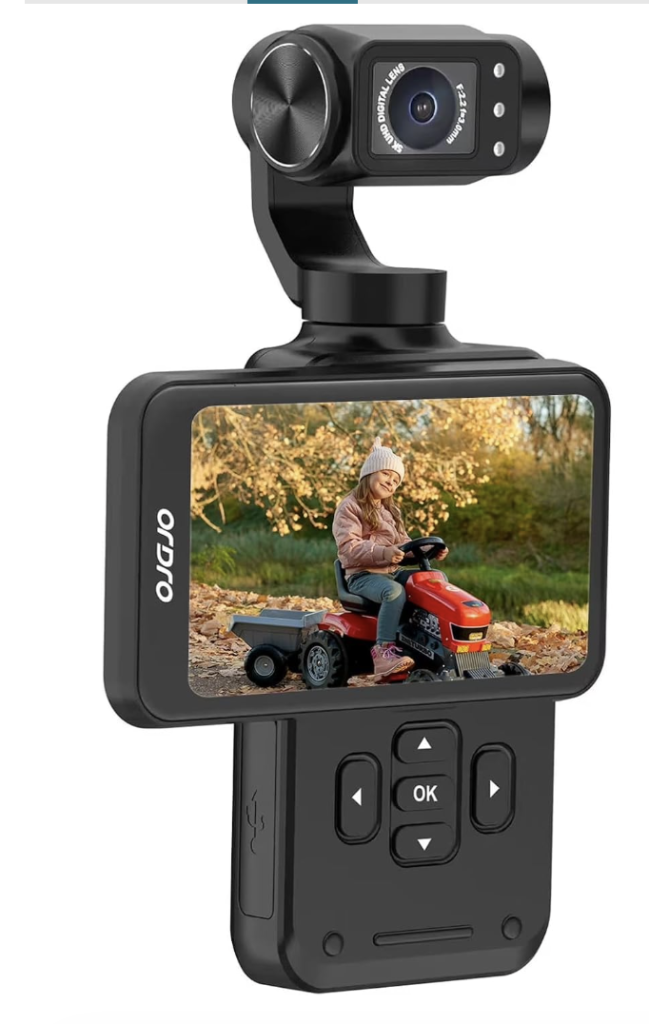
The ORDRO M5 focuses on accessibility and convenience. It offers a large 3.5-inch screen, 5K and 4K recording modes, infrared night vision, a wide-angle lens and approximately three hours of advertised battery life.
Main Difference
The most important difference is the image sensor.
The Xtra Muse uses a 1-inch CMOS sensor, while the ORDRO M5 uses a much smaller 1/2.5-inch 8MP CMOS sensor. The larger sensor gives the Xtra a significant potential advantage in low-light performance, dynamic range, subject separation and overall video quality.
The Xtra also records 4K slow-motion video at up to 120fps and offers a 10-bit X-Log color profile for more flexible editing. The ORDRO reaches 4K at 60fps or an advertised 5K mode at 30fps, but it does not offer an equivalent 10-bit log profile.The Xtra is therefore the more advanced camera for creators who care about cinematic image quality. The ORDRO is the simpler option for beginners who value a larger screen, night vision and easy operation.
Video Resolution and Frame Rates
The Xtra Muse captures 4K slow motion at 120 fps and normal video in 4K. This lets filmmakers slow down sports, movement, travel, and B-roll in 4K.
ORDRO M5 supports:
5K at 30fps 4K at 60fps or 30fps
2.7K 60/30fps
Up to 120fps in 1080p and 240fps in 720p.
Its high-frame-rate options are excellent for recreational slow motion, but 4K recording ends at 60fps.
ORDRO has a 5K output mode. For picture quality and professional editing, the Xtra's bigger sensor, 4K/120fps recording, and 10-bit colour are better.
Most advertised output resolution: ORDRO M5.
Best HD video modes: Xtra Muse
Video resolution/framerate
The Xtra Muse captures 4K slow motion at 120 fps and normal video in 4K. This lets filmmakers slow down sports, movement, travel, and B-roll in 4K.
ORDRO M5 supports:
1. 30fps 5K
2. 4K 60/30fps
3. .7K 60/30fps
Up to 120fps in 1080p and 240fps in 720p.
Its high-frame-rate options are excellent for recreational slow motion, but 4K recording ends at 60fps.
ORDRO has a 5K output mode. For picture quality and professional editing, the Xtra's bigger sensor, 4K/120fps recording, and 10-bit colour are better.
Most advertised output resolution: ORDRO M5.
Best HD video modes: Xtra Muse
Colour and Post-Production
Xtra Muse records 10-bit X-Log.
Sky, sunset, wall, and skin tone gradients are smoother with 10-bit footage because it captures more colour information than 8-bit video. X-Log allows additional editing freedom for contrast, highlights, shadows, and colour. The official X-Log-to-Rec.709 LUT is available for download on Xtra.
This makes the Xtra better for:
Cinematic trip clips
Pro colour grading
Images with high contrast
Sunrise and sunset footage
Video matching from several cameras
Professional software editors
The ORDRO M5 does not promote a 10-bit log profile for MP4 video. Its film looks well for casual watching and sharing without colour adjustment.
Beginners may find ORDRO simpler, but advanced editing is limited.
Colour and post-production champ: Xtra Muse
Performance in Low Light
The Xtra Muse's bigger 1-inch sensor could improve standard low-light images.
Xtra claims a 4K 30fps low-light mode. The bigger sensor is intended for cleaner video in restaurants, indoor events, city streets, and nighttime travel.
The ORDRO M5 has infrared night vision and a smaller sensor than the Xtra.
The M5 can record monochrome video in low-light conditions with its three infrared LEDs. This may help:
Wildlife observation
Walks at night
Paranormal/exploration videos
Security-style recordings
Nighttime animal recording
Specific documentary scenarios
Conventional low-light video has more realistic colours and cinematic quality than infrared. It is a functioning darkness recording mode, not a huge sensor.
Best natural low-light photo: Xtra Muse
The ORDRO M5 records best in full darkness.
Stabilisation
A mechanical three-axis gimbal is used by both cameras.
The camera may be physically adjusted for movement and rotation using a mechanical gimbal. As a rule, this yields better, more organic stabilisation than using just electrical cropping.
Stabilise your handheld travel, jogging, trekking, and walking video with the Xtra Muse. For independent artists working alone, it offers a system that incorporates smart tracking and framing capabilities.
In addition to its many controls, the ORDRO M5 has three-axis stabilisation:
Shift Follow Follow Pan
Nothing Unlocked
Everything That Comes After
Speed control for the gimbal
The Practice of Facial Recognition
ORDRO also has electronic stabilisation built in, so it can operate in tandem with the mechanical system.
Compared to a regular handheld compact camera, the video from any of them should be much smoother. Nevertheless, the quantity of axes is insufficient to ascertain the quality of stabilisation. Image processing, motor tuning, and tracking software all play a role in the end product.
Both the ORDRO and the Xtra have more pronounced manual gimbal controls, but the ORDRO is marketed as the superior creative camera.
Xtra Muse has a little edge in the stabilisation area.
Top choices for manual gimbal control: ORDRO M5
Screen and Framing
The ORDRO M5 has a major screen-size advantage.
It includes a 3.5-inch IPS touchscreen with a resolution of 1280 by 720 pixels. The screen rotates to support both horizontal and vertical filming. Its larger size makes menus, framing and footage review easier to see.
The Xtra Muse uses a smaller 2-inch rotating touchscreen. The display supports quick switching between landscape and portrait orientations.
The smaller screen helps the Xtra maintain a compact camera-style form, but the ORDRO’s display is more comfortable for beginners, users with reduced vision and creators who frequently review footage directly on the camera.
Screen winner: ORDRO M5
Best compact interface: Xtra Muse
Microphone and Audio Support
The Xtra Muse supports external digital microphones through USB-C. A compatible adapter can also be used for microphones with a 3.5mm connection.
Xtra’s published information about direct Bluetooth microphones is currently inconsistent. The main product FAQ states that direct Bluetooth microphone connection is not supported, while newer Xtra promotional material and third-party reporting describe Bluetooth audio compatibility after firmware updates. Buyers should confirm compatibility with their exact microphone before purchasing.
The ORDRO M5 includes a built-in microphone and a direct 3.5mm external microphone input. ORDRO also sells bundles with wireless microphone receivers that connect to the camera.
The ORDRO’s standard 3.5mm input is simpler for conventional wired microphones. The Xtra provides a more modern USB-C workflow, but some microphones may require a receiver or adapter.
Simplest wired-microphone connection: ORDRO M5
Best potential wireless ecosystem: Xtra Muse, after checking compatibility
Final Verdict
The Xtra Muse is the better vlogging camera overall.
Its 1-inch sensor, 4K/120fps recording, 10-bit X-Log profile, stronger low-light potential and more advanced creator features place it in a higher image-quality category than the ORDRO M5.
It is the better option for travel creators, filmmakers, professional social-media content, cinematic B-roll and users who plan to edit and color-grade their footage.
The ORDRO M5 is the better specialized budget option when it is available at a genuinely low price.
Its large 3.5-inch screen, infrared night vision, wide field of view and longer advertised battery life make it accessible for beginners and useful for unusual nighttime recording situations.
Choose the Xtra Muse when image quality, slow motion, tracking and professional editing are the priorities.
Choose the ORDRO M5 when ease of use, screen size, infrared recording and a lower purchase price matter more than sensor quality.