
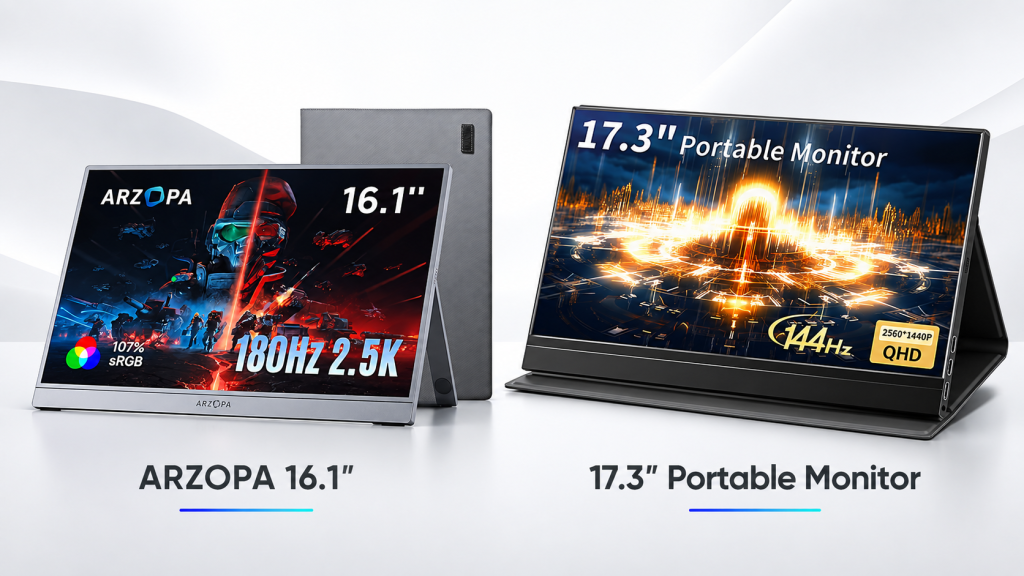
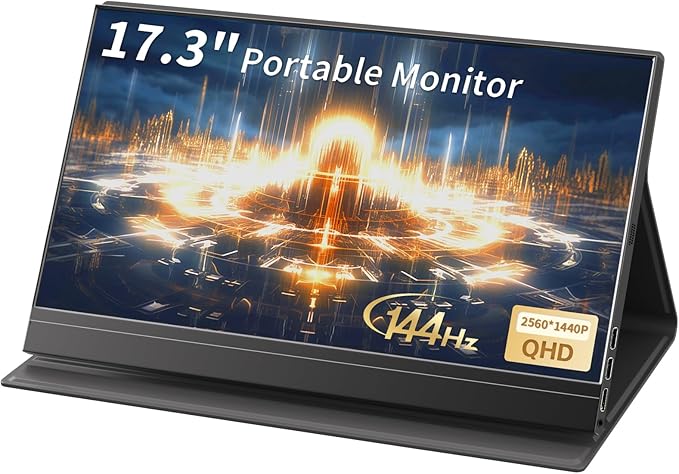
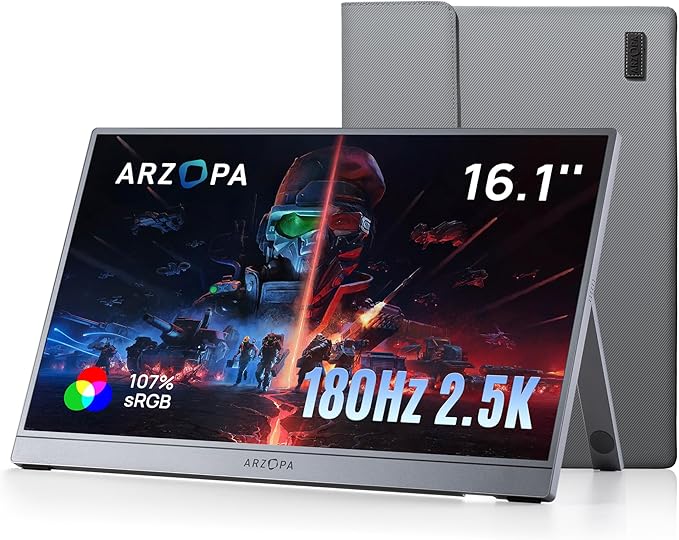
Looking for a portable gaming monitor that can also serve as a second screen for work, travel, or content creation? Here, we compare the ARZOPA Z3FC 16.1-inch 180Hz 2.5K Portable Monitor with the StarXnDa 17.3-inch 144Hz 2.5K Portable Gaming Monitor.The second product’s Amazon listing identifies it as a StarXnDa monitor, even though the brand is not included in the title provided.
Main Differences
The ARZOPA Z3FC is the better option for users who prioritize gaming performance, brightness, portability, color coverage, and a convenient integrated stand. It offers a refresh rate of up to 180Hz, 400-nit brightness, 107% sRGB coverage, FreeSync, an aluminum-alloy body, and a monitor-only weight of approximately 780 grams.
The StarXnDa 17.3-inch monitor is designed for users who prefer a larger screen and more installation flexibility. Its main advantages are the 17.3-inch panel, magnetic protective cover, and VESA-mounting support. However, it is limited to 144Hz, has a lower advertised brightness of 250 nits, and its product listing provides less detailed information about color accuracy and construction quality.
Screen Size and Resolution
Both monitors use a 16:9 IPS panel with a resolution of 2560 × 1440 pixels. This means that both provide a considerably sharper image than a typical 1080p portable monitor, particularly when displaying text, detailed game environments, spreadsheets, editing timelines, and high-resolution photos.
The StarXnDa offers the larger display at 17.3 inches, compared with 16.1 inches on the ARZOPA. That additional space can make games more immersive and improve productivity when working with several windows.
However, because both screens have the same resolution, the smaller ARZOPA has a slightly higher pixel density. The ARZOPA provides approximately 182 pixels per inch, while the StarXnDa provides around 170 pixels per inch. The difference is not dramatic, but text and fine details may look slightly sharper on the ARZOPA.The StarXnDa is better when physical screen size is the priority. The ARZOPA is better when portability and pixel density matter more.
Gaming Performance and Refresh Rate
The ARZOPA has the stronger gaming specification. It supports refresh rates of up to 180Hz when connected through a compatible USB-C DisplayPort connection. Its Mini HDMI connection is limited to 144Hz. The monitor also supports FreeSync, which can help reduce screen tearing when the frame rate changes during gameplay.
The StarXnDa reaches a maximum refresh rate of 144Hz and advertises a response time of 3 milliseconds. Its Amazon specifications also list FreeSync support. This remains more than sufficient for most games, including racing titles, shooters, action games, and competitive multiplayer experiences.
The difference between 144Hz and 180Hz is visible, but it is not as transformative as moving from 60Hz to 144Hz. Players with a sufficiently powerful gaming PC will benefit most from the ARZOPA’s additional refresh-rate headroom.
For PS5 and Xbox Series X users, the difference is less important because both consoles support gameplay at up to 120 frames per second in compatible games. Consequently, either monitor has enough refresh-rate capacity for current console gaming.For competitive PC gaming, the ARZOPA wins. For console gaming, both provide similar practical refresh-rate capability.
Color Quality and HDR
The ARZOPA provides the more complete and transparent color specification. It uses an 8-bit IPS panel, covers a claimed 107% of the sRGB color space, supports HDR10, and has a rated contrast ratio of 1000:1.
These specifications make it suitable for gaming, streaming, presentations, general photo editing, social-media content, and everyday creative work. However, an independent review found that it was better suited to general digital content than professional color-critical production.
The StarXnDa also advertises an IPS panel, HDR, 8-bit color depth, and reproduction of 16.7 million colors. However, its listing does not provide an equally clear, reliable sRGB coverage figure. This makes it more difficult to evaluate its factory color accuracy or suitability for professional editing.
Both monitors support HDR signals, but buyers should maintain realistic expectations. Neither is comparable to a premium Mini-LED or OLED HDR monitor. The 8-bit panels and relatively modest brightness levels limit highlight intensity and overall HDR impact.
The ARZOPA is the safer choice for users who care about consistent color and better-documented display performance
Portability and Construction
The ARZOPA Z3FC has a clear advantage for frequent travelers. It weighs approximately 780 grams, measures only 9.3 millimetres at its listed depth, and uses an aluminum-alloy body. It also includes a built-in adjustable kickstand and a protective sleeve.
The integrated kickstand is particularly convenient because the monitor can be positioned without attaching a separate cover or folding a magnetic case into the correct shape. It can also be used in horizontal or vertical orientation, depending on the connected device and operating-system settings. An independent review praised the model for combining a lightweight design with practical work and gaming performance.
The StarXnDa is naturally larger because of its 17.3-inch panel. Amazon lists dimensions of approximately 15.5 × 9.6 × 0.49 inches and an item weight of 2.32 kilograms. However, the listing does not clearly explain whether that weight includes the magnetic case, cables, accessories, or packaging.
Its magnetic case protects the screen and folds into a stand. This reduces the need for a separate carrying case, but magnetic-cover stands can require more desk space than integrated kickstands and may be less convenient on narrow surfaces.
The ARZOPA is easier to carry. The StarXnDa provides more screen area but is the bulkier travel option.
Important Limitations
The ARZOPA’s 180Hz mode requires a compatible USB-C DisplayPort connection. Through HDMI, it is limited to 144Hz. Buyers who connect it only through Mini HDMI should therefore not purchase it solely for the advertised 180Hz capability.
The StarXnDa’s 250-nit brightness is its biggest practical limitation. It should perform adequately indoors, but users working in bright locations may find it noticeably less visible than the ARZOPA.
Neither monitor has a battery, touchscreen functionality, or truly high-end HDR performance. Both may also require external power to operate reliably at maximum brightness and refresh rate.
Final Verdict
The ARZOPA Z3FC is the better overall portable monitor. It offers stronger gaming performance, higher brightness, clearer color specifications, lower weight, a more convenient stand, and better-documented features.
The StarXnDa 17.3-inch monitor remains an interesting alternative for users who value screen size and VESA compatibility above maximum portability. Its larger panel can provide a more immersive experience, but the lower brightness and less detailed product documentation make it a more cautious recommendation.
For frequent travel, competitive PC gaming, and mixed work-and-play use, choose the ARZOPA Z3FC.For a larger indoor screen that may also be mounted on a monitor arm, choose the StarXnDa 17.3-inch.